How do robots work?Robotics is already a working tool for business.
In restaurants robots deliver dishes, in business centers they keep floors clean, in agriculture they treat crops from the air. These aren’t demo prototypes — it’s equipment with a clear job, configuration and service model.
Free, no calls. The result appears right on screen.
Sounds complexand expensive? Let’s take it apart.
“It’s expensive”
A server robot costs about three–four months of two employees’ wages — and works for years without days off. Typical payback is 9–14 months. After that it earns for you.
Verdict: pays back in 9–14 mo
“It’s complicated”
A modern service robot starts up almost like a robot vacuum: it maps your space by itself in one pass. Our engineer sets everything up and trains your team in a day.
Verdict: launched in one day
“What if it breaks?”
Support in your language, spare parts in stock, warranty on every unit. Anything serious — we repair or replace. That’s our job, not your worry.
Verdict: warranty + parts in stock
We mean “take apart” literally. Below, this machine is laid out layer by layer.
What’s inside the robotthat scrubs your floors
Keep scrolling — we’ll split the NX-S200 scrubber into four “organs”. Understand one robot, and you understand any robot in the catalog.
Floor-scrubbing robot
One robot. Four organs.
This is a serial floor scrubber from our Guangzhou warehouse. Keep going — we’ll split it into eyes, hands, heart and brain.
/ NX-S200 · up to 5,000 m²/shift
360° lidar & 3D cameras
It sees. Everything.
A laser rangefinder scans the room ten times a second: people, chairs, glass doors. The robot spots an obstacle and glides around it before you even turn your head.
/ Lidar 360° · 10 scans/sec
Brush module
Cleans for three.
Two brushes, a water dosing system and a vacuum squeegee: up to 5,000 m² per shift, the floor dry right behind the robot. No breaks, no sick days.
/ 2 brushes · up to 5,000 m²/shift
LiFePO₄ battery
A 6-hour shift. Self-charging.
One charge covers a full night shift. At 15% the robot drives itself to the dock, charges and resumes exactly where it stopped.
/ LiFePO₄ · ~6 h · auto-dock
SLAM navigation
Mapped the floor in one pass.
On day one the robot drives around the floor and memorises the plan — like a robot vacuum, only across thousands of square meters. After that it’s a tablet: pick a zone, press start.
/ SLAM · map in 1 pass · tablet
Ready for the shift
Assembled. Off to work.
Not a prototype: machines like this already scrub business centers. Below is one of their stories — then we take apart its “siblings”: a delivery robot and an agri drone.
/ Serial unit · GZH-01 warehouse
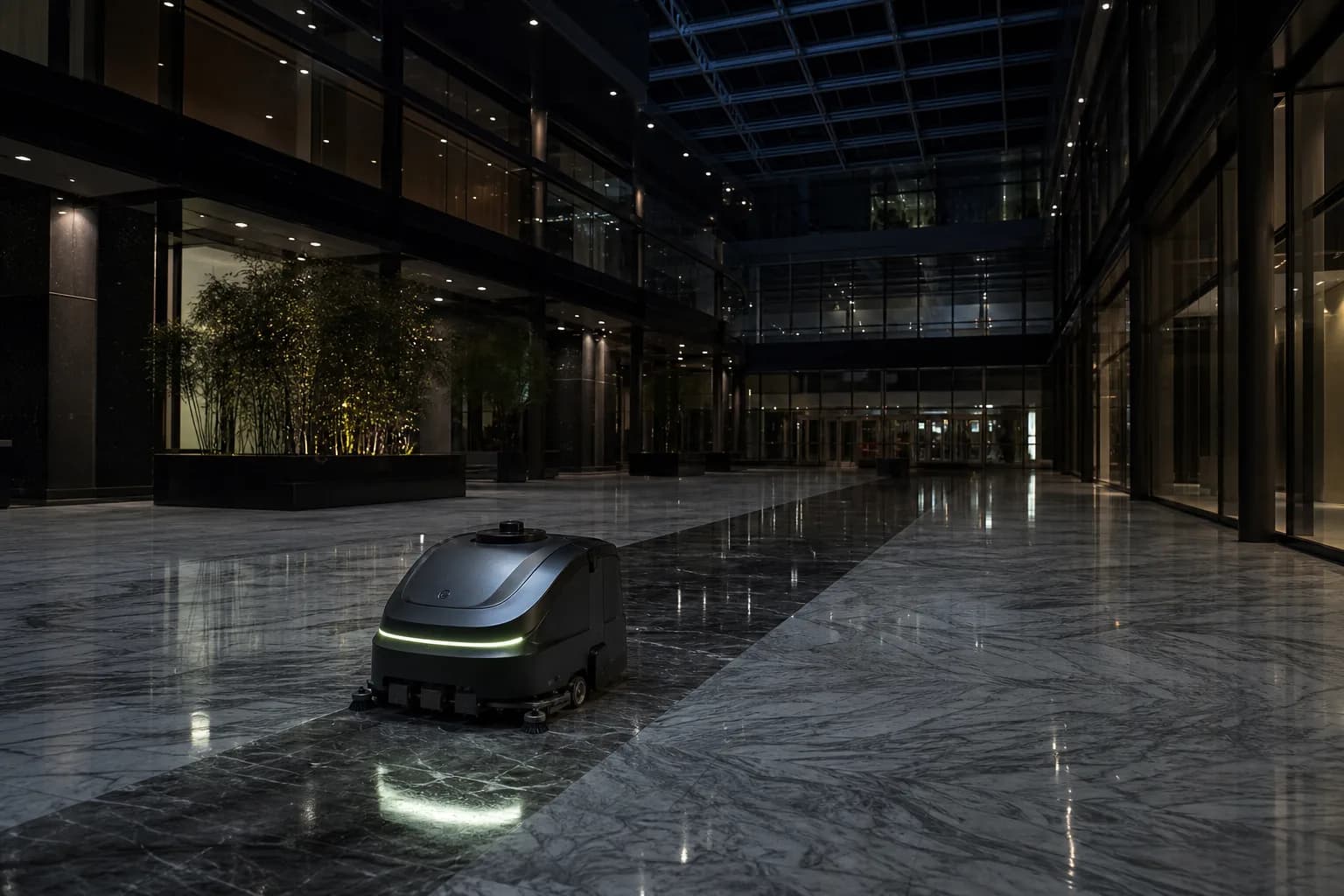
Floors get cleaned while everyone sleeps
- Day 1
The robot walked the floor and built a plan. Schedule set: every night, from midnight.
- Every night
Scrubs thousands of square meters on its own: avoids obstacles, refills water, docks to charge.
- Month 3
Cleaning contractor — two positions fewer. Floors shine every morning, tenant complaints are gone.
/ from $17,000 · up to 5,000 m² per shift · payback ~12–18 mo
Now — the waiter.The same four organs.
A different body — a tower with three trays. Same anatomy: eyes, hands, heart and brain. Scroll and see for yourself.
Delivery robot
Same principle. Different body.
A serial waiter robot: a tower with three trays on a wheeled base. We take it apart by the same four organs.
/ NX-D100 · 3 trays · up to 30 kg
Lidar & stereo cameras
Sees the hall. And kids by the table.
A lidar on top and cameras all around: the robot notices guests, chairs and a running kid, brakes softly and politely drives around. The glasses don’t even clink.
/ Lidar 360° + cameras · stops in 0.5 s
Three suspended trays
Three tables per run.
Each tray holds up to 10 kg on a soft suspension: soup arrives full, plate stacks intact. Hundreds of runs a night, zero breaks.
/ 3 trays · up to 10 kg each
LiFePO₄ battery
Lasts the shift. And another one.
One charge covers 12–24 hours of service. Battery low? A swap takes a minute — the robot goes back to guests, not to a socket.
/ LiFePO₄ · 12–24 h · 1-min swap
Hall map & order queue
Table 7 is just a button.
On the first evening the robot memorises the hall. Then a server loads dishes, taps a table number — route, order queue and detours are computed automatically.
/ Map in 1 evening · order queue
Ready for the evening
Assembled. Off to the guests.
Machines like this already serve dishes across the CIS and Dubai. One of their stories is below.
/ Serial unit · GZH-01 warehouse

Friday night — no kitchen delays
- Day 1
Delivered and switched on. The robot drove around the hall and memorised the map — tables, aisles, kitchen.
- Week 1
Staff stopped running with trays: the robot carries dishes, servers spend time with guests.
- Month 3
Friday rush is handled by the same team. Average check and tips are up — guests get real attention.
/ from $14,000 · carries for two · payback ~9–14 mo
And finally — wings.Organs — the same.
The agri drone looks the most complex. But watch: eyes, hands, heart, brain — you already know all of it.
Agricultural spraying drone
Same organs. Now airborne.
A serial sprayer: a frame with four rotors, a solution tank and a nozzle boom. One last teardown — by the familiar scheme.
/ NX-A300 · 12–18 ha/hour
RTK navigation & terrain radar
Knows its position. To a centimeter.
RTK satellite navigation keeps the drone on line within ±2 cm, and the terrain radar holds the set height above the crop even on sloping fields.
/ RTK ±2 cm · terrain radar
Rotors & nozzles
A hectare in four minutes.
The rotors carry up to 50 liters of solution; nozzles lay it in an even 5–9 m band. Downwash presses droplets onto the leaves — where a tractor can’t reach.
/ Tank up to 50 L · 5–9 m band
Swappable batteries
Battery swap in 30 seconds.
Flying is energy-hungry, so there are several batteries: one in the air, another charging from a generator. Rotate them — and the drone works all morning non-stop.
/ 30 Ah · battery rotation
Field map & passes
Draw the field with a finger.
Outline the field on your phone — the drone slices it into passes, flies the pattern, reports hectares covered and returns to the start point.
/ Map from a phone · auto passes
Ready for takeoff
Assembled. Off on a pass.
Eyes, hands, heart, brain — now you understand any robot in our catalog. All that’s left is to pick yours.
/ Serial unit · GZH-01 warehouse

The field is sprayed before lunch
- Morning
The drone lifts off right from the pickup bed. Field map loaded from a phone.
- One hour
12–18 hectares sprayed precisely to the map — no wheel tracks or crushed rows, unlike a tractor.
- Season
Up to 30% savings on chemicals and water: the drone applies exactly where and exactly as much as needed.
/ from $20,000 · 12–18 ha/hour · up to 30% chemical savings
How it workswith Nexum
You don’t need to understand robotics. We do — 15 years of China sourcing, a team in Guangzhou, legal entities and service in your region.
- Stage 01
Tell us the problem
In your own words: “server turnover”, “cleaning eats the budget”, “can’t spray in time”. That’s enough.
- Stage 02
We select and calculate
We propose 2–3 models for your budget and calculate payback on your numbers — honestly, with delivery and customs included.
- Stage 03
We show it live
A live video demo from our Guangzhou warehouse: the robot drives, you watch and ask questions. Or we bring a demo to you.
- Stage 04
We deliver and launch
Shipping, customs, on-site setup, team training — all on us. You get a working robot, not a box.
- Stage 05
We stay close
Warranty, spare parts in stock, support in your language, updates. The robot must work, not sit idle.
Try itbefore you buy
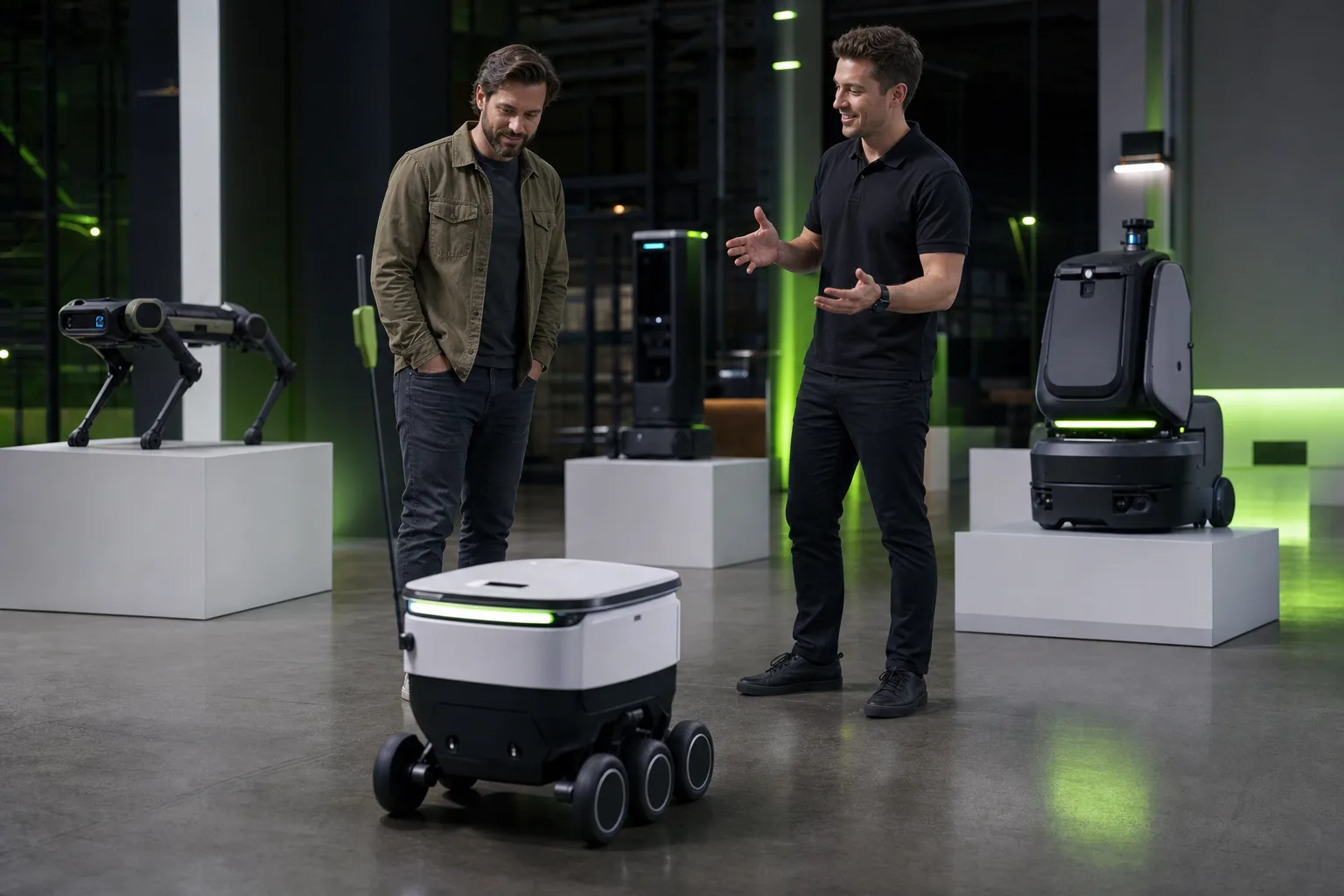
A 15-minute video call — and you watch a robot at work, live
2-minute audit
01 · 2 minFive simple questions about your business — and you’ll see which robots fit you and what they save.
Live demo
02 · onlineA 15-minute video call from our Guangzhou warehouse: a robot drives for you live. No slides — just the machine at work.
Pilot launch
03 · on-siteFor larger sites: we bring a robot to you, set it up and let it work. Decide while looking at real results.
You probablywant to ask
Do I need a programmer on staff?
No. Day-to-day control is from a tablet or phone — “pick a zone, press start” level. Setup is done by our engineer.
Will our premises work?
In most cases yes: robots need aisles of 70–80 cm and a reasonably even floor. Unsure — send a plan or a video, we’ll tell you honestly.
How long is delivery?
Popular models ship from stock within a day. Made-to-order — usually 3–5 weeks including delivery and customs, the date is fixed in the invoice.
What will employees say?
The pattern is the same everywhere: robots take the least-loved routine — trays, floors, monotonous rounds. People get to work with people.
Paperwork and warranty?
A contract with our legal entity in the jurisdiction convenient to you (Dubai, Hong Kong, China, Belarus), invoice payment, warranty and certification for your market.
Where do I start?
With the 2-minute audit — it’s free and instantly shows robots that fit. Or just write to us, we reply within one business day.
Describe your problemin your own words
We reply within 1 business day. No spam, no pushy calls.
Every robot in the catalog works like this
Find out in 2 minutes which one pays off for you — free, with the result right on screen.